Executive summary
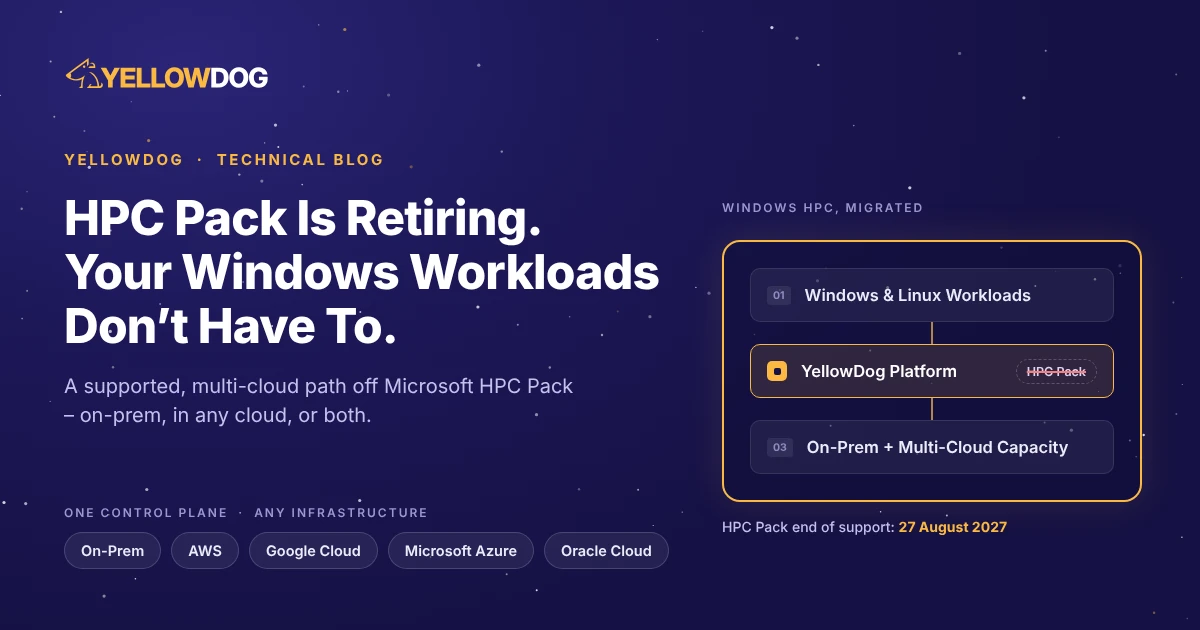
In late August 2026, Microsoft announced the retirement of all versions of HPC Pack, its Windows-based HPC scheduler. End of Support is 27 August 2027. Until then, customers get retirement-only support – essentially security fixes and existing documentation. After that date, clusters will keep running, but with no updates, no fixes and no technical support.
For organisations running risk grids, engineering simulation farms and research clusters on Windows, that’s a short runway to replace a core piece of infrastructure. And Microsoft’s recommended destinations – Azure Batch, Azure CycleCloud or a self-built cluster on Azure VMs – are all Azure-only. None of them is a like-for-like replacement.
YellowDog gives HPC Pack customers a different option: a single platform that schedules and provisions Windows and Linux workloads across on-prem servers and AWS, Google Cloud, Azure and Oracle Cloud, so you can migrate on your terms rather than Microsoft’s.
A year isn’t long for a scheduler migration
HPC Pack has been a fixture of Windows HPC for well over a decade. Over that time it has become tightly woven into how many enterprises work: SOA-style services, Excel offload, Windows-native job submission, Active Directory-based access and years of PowerShell admin scripts.
Replacing that in twelve months means discovery, re-platforming, validation against production results and a controlled cutover – all while the business keeps running its overnight batches and month-end reports. Teams still on HPC Pack 2016 have even less time: that version retires on 12 January 2027, and there’s no in-place upgrade path between major versions.
Leaving it too late is also risky. From 27 August 2027, any HPC Pack cluster becomes unsupported software sitting in the middle of business-critical workloads. That isn’t a position most risk, audit or security teams will accept for long.
Why the obvious alternatives don’t fit everyone
Microsoft’s guidance points customers to Azure Batch, with CycleCloud and custom Azure VM clusters as alternatives. Microsoft itself is clear that none of these guarantees one-to-one feature parity. For many HPC Pack customers, the gaps are significant:
They’re Azure-only. There’s no on-prem successor. If you have data sovereignty requirements, air-gapped environments or a large investment in your own servers, Microsoft’s guidance doesn’t help you.
They change the operating model. Azure Batch replaces a cluster you own with a service you subscribe to. That’s a re-architecture, not a migration.
They’re all Linux-first. Most of CycleCloud’s scheduler options come from the Linux world, which is little help if your workloads depend on Windows applications, .NET libraries or Excel.
They lock in a single cloud. Moving everything onto one provider, just as GPUs and memory capacity become harder to find and more expensive.
How YellowDog replaces HPC Pack
YellowDog is a workload management and orchestration platform built to run large-scale compute wherever the best resources are available. For HPC Pack customers, that means:
Windows and Linux, side by side. YellowDog schedules work onto Windows and Linux worker nodes, so existing Windows applications can move across without being rewritten for Linux. Teams that want to migrate parts of their estate can do it gradually rather than all at once.
Keep your on-prem estate. YellowDog runs workloads on your own servers and in your cloud accounts. Your existing HPC Pack compute nodes can become YellowDog workers, so the hardware you’ve already paid for stays in service.
Burst to any cloud, not just one. When on-prem capacity runs out, YellowDog provisions compute across AWS, Google Cloud and Oracle Cloud as well as Azure. Our waterfall provisioning works through zones, regions and providers until it finds the right instances, at the right price, ordered by cost, performance or both.
Your data stays yours. Workloads run in your data centre or your own cloud accounts. Data doesn’t pass through YellowDog infrastructure.
Migrate in phases, not in a weekend. Because YellowDog supports meta-scheduling, it can sit alongside existing schedulers during the transition. You can move workloads across one application or team at a time, validate results against HPC Pack and retire the old cluster only when you’re ready.
What this means for your stakeholders
HPC and platform teams: A supported replacement for HPC Pack that runs on-prem and in the cloud, without rebuilding everything around a single provider’s proprietary service.
Application owners: Windows workloads keep running on Windows. No forced port to Linux just to stay supported.
Quants and engineers: More capacity on demand when you need it, instead of waiting in the queue for a fixed-size cluster.
Infrastructure and security leaders: A clear route off unsupported software before August 2027, with data kept in your own environment and access tied to your existing identity controls.
Finance and FinOps: Cloud usage you can see, cap and optimise, instead of a lift-and-shift that quietly inflates the bill.
Looking ahead
HPC Pack’s retirement is a forced move, but it’s also an opportunity. Instead of swapping one vendor lock-in for another, enterprises can use this deadline to move to a compute layer that spans their own hardware and every major cloud. And that will keep finding capacity as their workloads grow into GPUs, AI and beyond.
The question isn’t whether you move off HPC Pack. It’s whether you want to be locked in again when you do.
Key takeaways
- Microsoft HPC Pack reaches End of Support on 27 August 2027 (HPC Pack 2016 on 12 January 2027), with retirement-only support until then.
- Microsoft’s recommended alternatives are Azure-only and not drop-in replacements, especially for on-prem and Windows-heavy estates.
- YellowDog runs Windows and Linux workloads across on-prem and multi-cloud infrastructure, so you can migrate in phases and avoid swapping one lock-in for another.
Don’t wait for the deadline. Our HPC Pack migration engagement follows five steps – Discovery, Analysis, Validation, Assurance and Optimisation – so you can plan, prove and cut over with confidence.
Book a demo or talk to our team at contact@yellowdog.ai to get started.