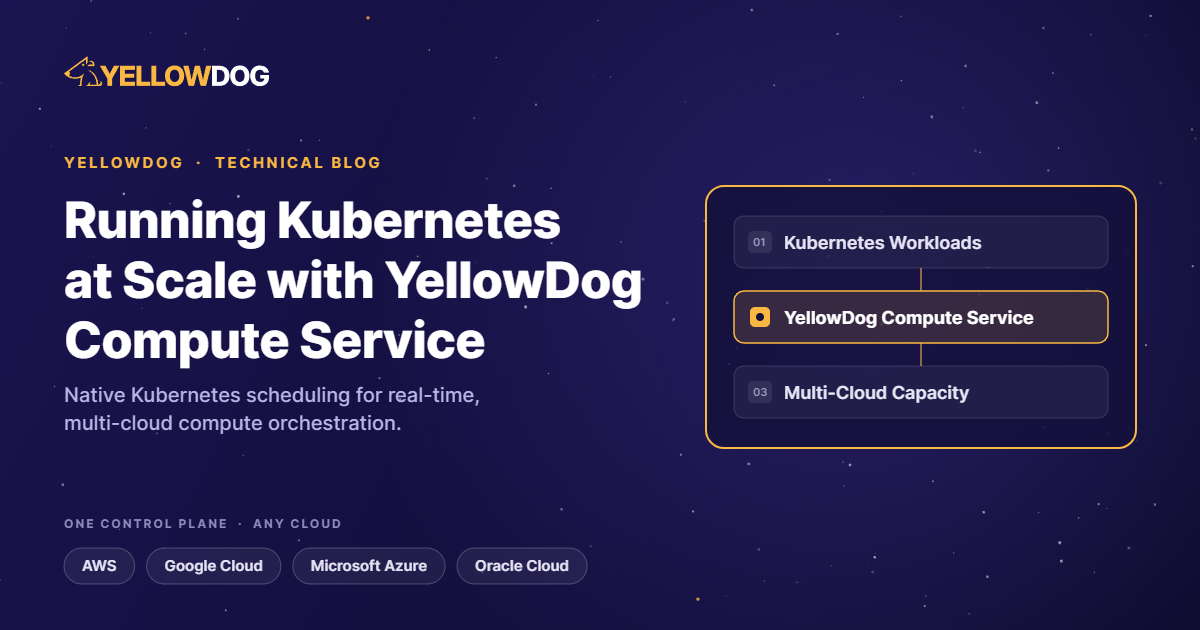
YCS brings native Kubernetes scheduling to real-time, multi-cloud compute orchestration.
Executive summary
For many teams running compute-intensive workloads, Kubernetes has become a familiar control layer for scheduling containers, standardising deployment patterns, and integrating with existing DevOps tooling. The challenge is that Kubernetes alone does not solve the hardest part of large-scale execution – which is finding the right compute capacity, in the right cloud or region, at the exact moment that the workload needs it. That challenge becomes more pronounced when workloads depend on scarce resources such as GPU instances, high-memory machines, or large parallel fleets.
YellowDog Compute Service (YCS) now adds native Kubernetes cluster provisioning, enabling technical teams to run workloads across multiple clouds and regions from a single YellowDog control plane. So, you can spin up Kubernetes clusters wherever the capacity exists – without rewriting your workflows or building custom provisioning logic for each cloud provider. In this blog, we’ll look at why Kubernetes needs a capacity-aware compute layer, how the YellowDog architecture works and keeps multi-cloud deployments secure, and what it means for your team.
Why Kubernetes needs a capacity-aware compute layer
In a conventional Kubernetes pattern, work is submitted to a cluster, and the underlying infrastructure is scaled to meet demand. This works well when capacity is readily available. However, it becomes less reliable when the required instance type is constrained; when a workload must span multiple locations; or when a pipeline needs to fail over quickly from one source of compute to another.
YellowDog enhances this model by allowing compute to be sourced, provisioned, and attached to Kubernetes clusters only when suitable capacity is confirmed. This gives you a more deterministic way to run large workloads, while still using the Kubernetes-native tools and processes you already know.
How the architecture works
At the centre of the architecture is the YellowDog control plane. From here, you can provision Kubernetes clusters across supported clouds and regions, manage compute requirements through a single interface, and distribute workloads according to policy, availability, and placement strategy. Kubernetes manages the containerised workloads, while YCS takes care of sourcing and provisioning the compute behind them.
This model is designed for heterogeneous compute at scale. Kubernetes workloads can run on dynamically provisioned superclusters, and the same orchestration approach will soon be extended to other cluster-based systems such as Slurm or Spark where teams need large, elastic pools of compute for batch, simulation, rendering, analytics, or AI workloads.
Secure deployment across cloud providers
YellowDog Kubernetes support is built for multi-cloud operation. Clients can provision and manage clusters across supported providers, including AWS, Google Cloud, Microsoft Azure, and Oracle Cloud Infrastructure. Each cluster is deployed as a secure, firewalled environment, with communication, authentication, user access, and API-driven control handled through existing YellowDog platform mechanisms.
For platform teams, this means Kubernetes can be introduced without forcing workload owners to individually manage provider-specific provisioning logic. The operational boundary is clearer: Kubernetes handles the workload lifecycle, while YellowDog handles secure access to distributed compute capacity.
Capacity-aware scheduling and workload placement
One of the key benefits of this integration is smarter workload placement. You can continue using Kubernetes-native tooling and workflows, while YellowDog’s scheduler distributes workloads across discrete Kubernetes clusters in different regions and cloud providers. YellowDog’s Best Source of Compute optimisation automatically identifies suitable available capacity based on factors such as cost, performance and availability, while features such as spot pre-emption handling and low-latency scheduling help workloads run efficiently.
This is particularly valuable for GPU-intensive workloads. Instead of sending a workload to a cluster, only to find that the required GPU instance type isn’t available, YCS can find and provision the right instance first, then attach it to the Kubernetes cluster once capacity is confirmed. YellowDog’s waterfall strategy can search across multiple regions and providers in parallel, reducing failed placement attempts and helping workloads start sooner.
What this means for technical teams
- Platform teams can expose Kubernetes-backed compute without building bespoke provisioning integrations for every provider.
- DevOps teams can continue using Kubernetes-native workflows while benefiting from YellowDog’s sourcing, provisioning, and scheduling capabilities.
- Workload owners can run their existing, demanding jobs across regions and clouds with a better chance of landing on available capacity quickly.
- Infrastructure leaders can treat distributed GPU and compute capacity as a unified resource pool rather than a set of isolated cloud accounts.
Looking ahead
Native Kubernetes support brings YellowDog Compute Service (YCS) a step closer to making distributed compute infrastructure easier to access and manage. As YellowDog Cloud evolves, teams will be able to access a wider global network of compute capacity through a single API, while continuing to use the Kubernetes tools and workflows they already know.
For technical teams, the benefit is simple: Kubernetes manages and orchestrates containerised compute workloads, while YellowDog finds and connects them to the compute capacity they need. Together, they create a more flexible and resilient way to run large-scale workloads across multiple clouds and regions.
Key takeaways
- Get capacity-aware scheduling without leaving Kubernetes-native workflows, with clusters provisioned by YCS.
- Find the right capacity more reliably, with YellowDog’s waterfall strategy and Best Source of Compute optimisation – particularly for hard-to-source GPUs.
- Skip the provisioning busywork, and let YellowDog handle security and access across clouds.
Book a demo or talk to our team at contact@yellowdog.ai to get started.