How Multi-Region Capacity Solves Scarcity
A typical GenAI team operating within a single cloud region faces an invisible ceiling: no matter how well they optimise their pipelines, they remain confined to the hardware available in that one location. When H100s are exhausted in their primary region they have no recourse but to wait, compromise on accelerator choice, or undertake costly re-engineering for alternative hardware if forced to do so.
Multi-region compute orchestration changes this entirely. By tapping into full availability of GPU capacity across multiple cloud providers and geographic regions, a smart orchestration layer can locate preferred accelerators wherever they exist, not just where the team’s cloud account happens to reside. It then maps that hardware directly onto existing pipelines – intelligently, transparently, with minimal uplift. This is not a capability that standard cloud consoles or native tooling provide; it requires a dedicated solution purpose-built to search, provision, and adapt across a fragmented global GPU landscape, delivering capacity that would otherwise remain invisible to the majority of enterprise customers.
The Intelligent Compute Layer: Orchestration Meets Global Capacity
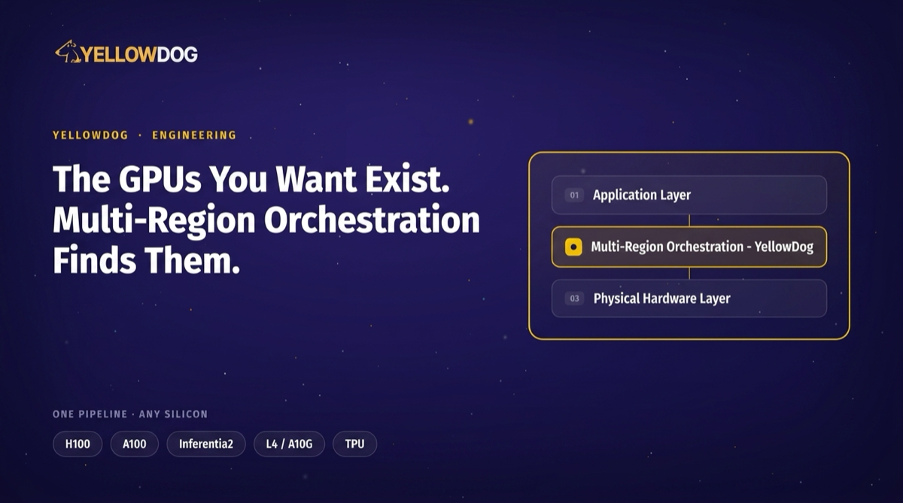
GenAI workloads flow through a modern abstraction stack, from application to orchestration to physical hardware. It is within the Orchestration Layer that YellowDog operates and it is here that the solution’s multi-region advantage becomes transformative.
At the Application Layer, teams define their workloads: LLM inference, RAG pipelines, or agentic engineering sessions. These requests pass down to the Orchestration Layer, where YellowDog’s Workload Manager takes over. Unlike standard schedulers that are confined to a single cloud region or availability zone, YellowDog dynamically sources compute globally, spanning multiple cloud providers and geographic regions simultaneously.
This is the critical differentiator. When a team requests H100s and their primary region is depleted, YellowDog does not return an error or suggest a downgrade. Instead, it scans across its global inventory to locate preferred accelerators wherever capacity exists, then provisions them intelligently. If the highest-priority hardware is unavailable everywhere, YellowDog automatically falls back to the next preferred family while ensuring existing pipelines continue to run without interruption.
At the Physical Hardware Layer, this manifests as a prioritised worker pool of accelerators that YellowDog provisions dynamically, with built-in support for Spot pricing and preemption recovery. The result is seamless: workloads flow down through the stack, YellowDog abstracts the complexity of global sourcing, and GenAI engineering teams gain reliable access to the hardware they need.
In short, YellowDog transforms the Orchestration Layer from a passive scheduler into an intelligent multi-region compute layer that turns global GPU fragmentation into a strategic advantage. Capacity is no longer a function of where a team’s cloud account happens to reside; it becomes a function of YellowDog’s ability to find, provision, and map preferred hardware across the globe.
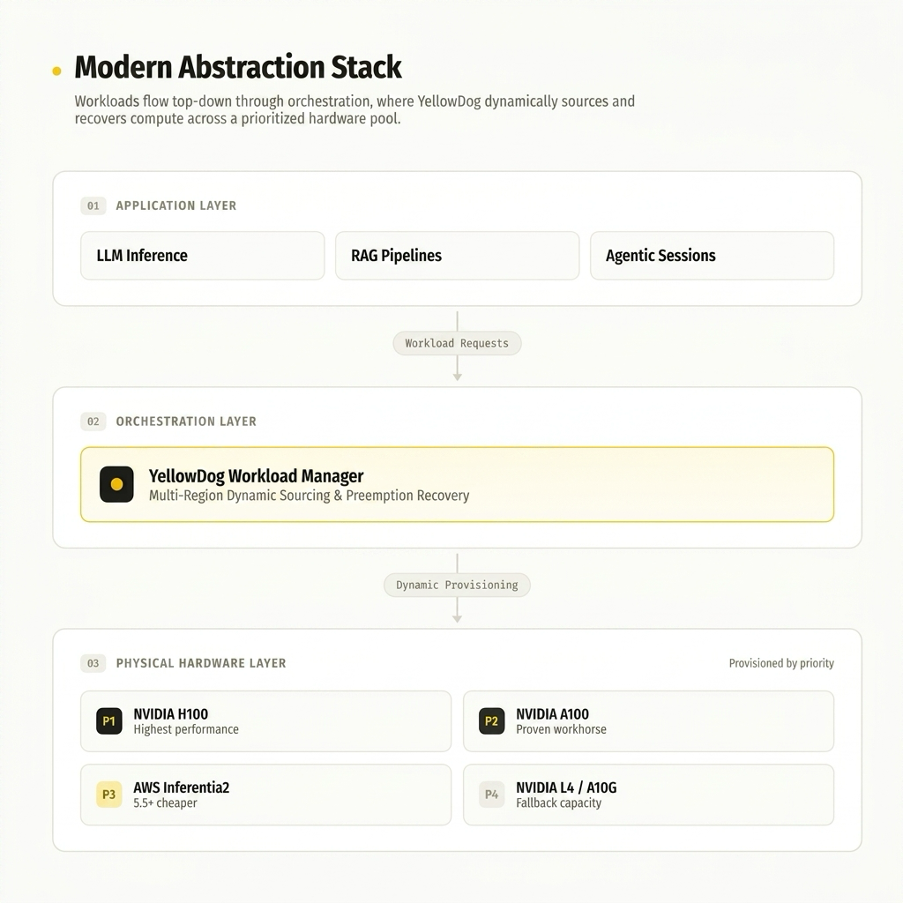
Fig 1: The Modern GenAI Abstraction Stack: Application Layer | Multi-Region Orchestration Layer | Physical Hardware Layer
By placing an intelligent orchestration layer between the AI control plane and cloud compute, organisations can treat compute as a reliable utility. The application pipeline is built once, and the orchestration layer dynamically selects the optimal hardware based on real-time cost, location, and availability without requiring teams to re-engineer their workloads.
This abstraction delivers three critical operational capabilities:
- Dynamic Fallbacks: When H100 capacity is exhausted in a region, the system automatically routes workloads to the next preferred accelerator – whether A100, L4/A10G, or AWS Inferentia2, ensuring pipelines continue running without interruption.
- Cost Optimisation: Workloads are automatically matched to the most cost-effective hardware. Lower-priority batch jobs and development workloads run on cheaper, older, or Spot-priced instances, while latency-critical production workloads are reserved for high-performance silicon.
- Multi-Region Resilience: Organisations are no longer locked into a single cloud provider’s GPU availability zones. Workloads can migrate across cloud boundaries to leverage available capacity wherever it exists, turning regional scarcity into a non-issue.
This is precisely the capability that YellowDog delivers: transforming the orchestration layer from a passive scheduler into a strategic compute engine that abstracts away the complexity of global GPU sourcing.
How It Works In Action
To produce validated architecture that delivers this level of intelligent orchestration, YellowDog partnered with HelixML using their private GenAI platform which is typically deployed directly inside a customer’s cloud account to run LLM inference, RAG pipelines, and agentic sessions. The YellowDog workload manager acted as an intelligent provisioning layer, dynamically selecting and managing GPU instances across multiple cloud regions based on real-time availability and cost. When preferred H100 instances were unavailable, YellowDog automatically routed the workloads to alternative hardware families like AWS Inferentia2 or NVIDIA L4, and utilised Spot instances with automated preemption recovery. This partnership demonstrated that complex AI pipelines can remain fully operational and cost-effective without manual pipeline re-engineering. Read the case study here.
Conclusion
The competitive advantage in generative AI is changing. It no longer belongs to only those who can simply acquire the most GPUs, advantage can gained by those who can abstract them and rely on intelligent orchestration. Enterprises that embrace intelligent hardware- orchestration insulate themselves from supply chain volatility, optimise compute spend automatically, and keep engineering teams focused on product value, not infrastructure complexity.
Take the First Step to Intelligent Hardware Orchestration
If your engineering team is losing capacity to GPU scarcity and infrastructure overhead, you do not have to commit to a major re-engineering effort immediately. The YellowDog structured five-step engagement playbook allows your team to identify, analyze, and validate new hardware options using your existing code, ensuring that engineering effort is only committed once confidence is production-grade. From mapping multi-cloud availability (Step 1: Discovery) and ranking price-performance (Step 2: Analysis), to running workloads before you commit (Step 3: Validation), confirming supply at scale (Step 4: Assurance), and configuring Spot optimisation (Step 5: Optimisation), each step produces a concrete deliverable.
Contact our team to begin your Discovery phase and reclaim your engineering velocity.